

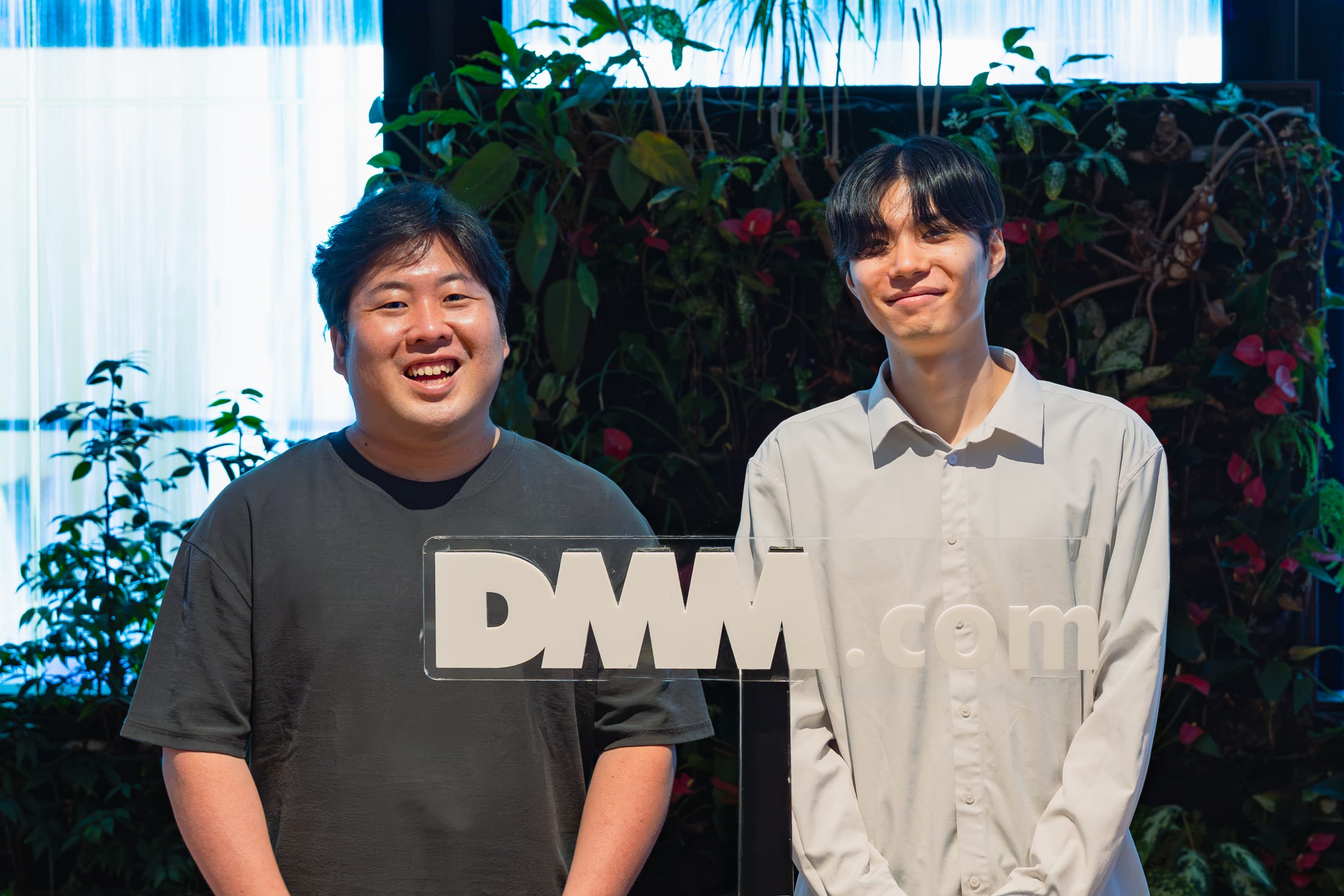
DMM Boost Co., Ltd. offers multiple SaaS products that help businesses drive repeat visits and attract new customers. Its inquiry management tool used to be disconnected from its customer management system, and every one of a large volume of inquiries was handled by people. By adopting Igness LAMP, the company unified inquiry and customer data in Salesforce and moved to a hybrid design that combines AI with human agents. We spoke with Asakawa and Sugisaki of DMM Boost about the changes this brought to both the CS team and its BPO partner, including cutting the escalation rate from the BPO team in half.
Highlights
- —Eliminated fragmented customer information by managing inquiry data and customer data in one place
- —Split inquiries between AI and human agents, improving the escalation rate by up to 50%
- —A knowledge improvement cycle born from evaluating the AI agent
About DMM Boost Co., Ltd.

First, tell us about your business.
Asakawa: We mainly offer three SaaS products. The first is "DMM Chat Boost," which streamlines communication with customers over LINE and maximizes the impact of repeat-visit promotion. The second is "DMM Geo Boost," an MEO (map engine optimization) service that contributes to new customer acquisition and branding. The third is "STAR BOOST," which supports effective customer acquisition by matching businesses with influencers.
What are your roles day to day?
Asakawa: I'm in the Corporate Planning Office, where I handle overall KPI management and medium- to long-term strategy.
Sugisaki: I'm responsible for improving and visualizing operations in the CS area. I also head the department that works with the external BPO team handling customer inquiries on our behalf.
Struggling with fragmented information and routine inquiries
What challenges did you face before adopting Igness LAMP?
Asakawa: Before Igness LAMP, DMM Boost had two major challenges. One was that our inquiry management tool and Salesforce weren't connected. The other was that we were handling everything by hand, including routine inquiries. We were dealing with a heavy volume of inquiries, weekends included.
Our main inquiry channel was LINE, and we were already using Salesforce for customer management at the time. But because the tool couldn't connect with the customer information in Salesforce, we couldn't see customers' details on the inquiry management side. So every time an inquiry came in, there was always an extra step: open Salesforce, look the customer up, and cross-check before responding. Because the tools weren't connected, this searching and cross-checking had to happen every single time, and it added up to a lot of work.
On top of that, people were handling even routine inquiries where the answer is the same no matter who responds, so replies took time and we kept customers waiting.
We had made responses somewhat more efficient with templates, but as long as every reply goes through a person, it inevitably takes time. We had long been asking ourselves whether we could build a system that answers customers smoothly on the spot, without a person in the loop.
What was the deciding factor in choosing Igness LAMP?
Asakawa: The turning point was a company-wide cost optimization policy. We were given the mission of reducing tool costs, and as we compared a range of tools, we set three conditions. First, it had to deliver lower tool costs. Second, it had to lay the foundation for managing customer information in one place with Salesforce. Third, it had to support everything through to analyzing the accumulated data, all in one place. Igness LAMP fit those three conditions perfectly.
The need for analysis in particular had a concrete goal behind it. Until then, our customer management data and inquiry data were siloed, so we couldn't analyze anything in the first place. By fixing that, we hoped to see how the number and types of inquiries changed by industry and by contract length, and use that to improve how we handle inquiries.
Designing inquiry flows that split responses between AI, human agents, and rule-based handling

After adopting Igness LAMP, how did you design your operations?
Sugisaki: After adopting Igness LAMP, we first worked on a design that splits inquiry handling three ways: AI, human agents, and rule-based handling. Routine inquiries that need little case-by-case judgment are handled by AI. Those that need individual investigation or emotional care go to a human agent. And when it's already clear what the customer wants to do or which procedure they need, we provide a form so they can apply directly from there.
What we kept in mind in the design was first creating a flow where customers can casually try asking the AI. If you point people to the human support channel right away, they tend to pick it as the safe option whenever they're unsure, and you can't fully leverage AI's unique strength of answering immediately, on the spot. So we aimed for a balance: prioritize a design where the AI resolves things smoothly, while making sure customers can switch smoothly to a human agent whenever they need to.
We also designed the handoff to human agents to happen naturally, following flows we set up in advance. Sometimes customers move to a human agent so smoothly they don't even notice, and sometimes an operator steps in proactively when they judge it necessary. On the case screen, you can see an "AI handling" status, so we can manage in real time which inquiries the AI is currently handling.
Letting AI handle inquiries so operators can focus on more complex cases
How have the challenges you had before changed?
Sugisaki: Since adopting Igness LAMP, Salesforce and LINE inquiries are linked on a single platform, so the work of opening contract information and cross-checking it for every response has disappeared entirely. Without the hassle of confirming who the customer is, we can get started on the response itself right away.
And because AI now handles many of the routine inquiries, the number of inquiries that need a human agent at first response has dropped to about half of what it was before. Operators can now concentrate on complex cases that require individual investigation or emotional care, which we see as a major benefit.
The frontline staff have responded very positively, too. Now that the CS team is clear on "which work to focus on," managers say operations have become easier to run and easier to manage. We've also shortened the lead time for responding to customer inquiries, and we really feel that we're able to respond right away.
Escalations cut in half — with effects that reached the BPO team

Have you seen any changes in the numbers since adoption?
Sugisaki: The clearest change in the numbers is the escalation rate from the BPO team we outsource inquiry handling to. Since the flows we set up around June took hold, some products have seen their escalation rate drop by 50% from where it started, and even the smallest improvement has been 30%. As handling time goes down, the cost of the BPO team comes down accordingly.
Inconsistency in response quality has also visibly changed. We share manuals and FAQs with our operators, but with human responses, differences in individual skill inevitably lead to variations in answers. The parts the AI answers come back consistent, so we almost never hear customers say, "That's different from what I was told last time."
The realization that "if the AI can't answer, the FAQ doesn't exist"

Has anything else changed since adoption?
Sugisaki: It has also given us new insight into how we run the CS team itself. We add our existing FAQs to the AI as knowledge, but back when everything was handled by people, it was hard to see which FAQs were missing. After adoption, we started to notice that inquiries the AI can't handle are ones where "the FAQ doesn't exist in the first place," and that led us to expand our user guide for customers.
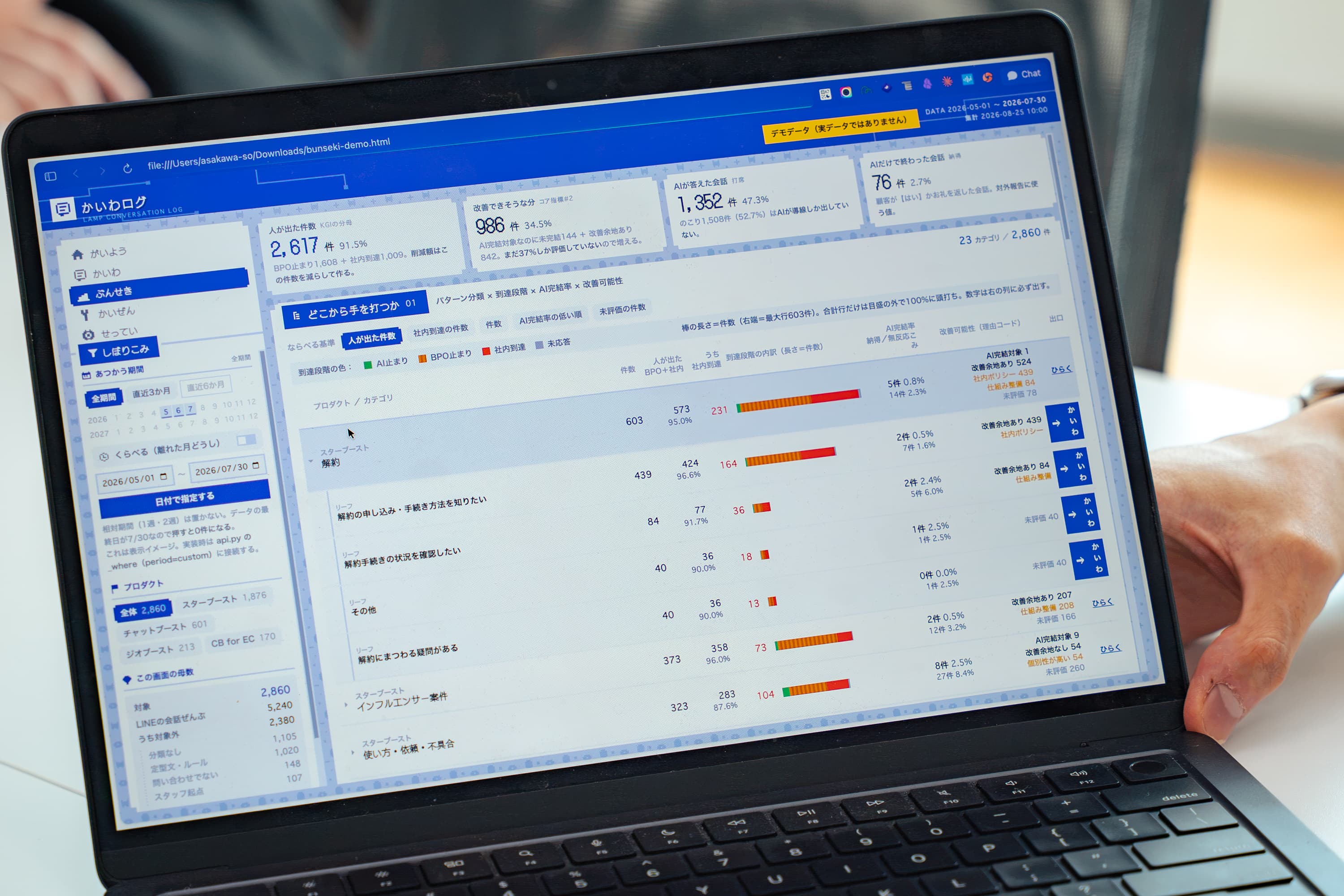
Asakawa: We're currently building a dashboard that sorts and analyzes conversation logs. By breaking down by category how many inquiries and what share were answered by people, and how much of that could be improved, we want it to make bottlenecks easier to pinpoint and become the starting point for discussions about improving operations.
The key to successful AI adoption: set goals and keep the feedback cycle turning

Do you have a message for companies facing similar challenges with inquiry handling?
Asakawa: Using AI or tools is only ever a means. I think what matters is to be clear about why you're doing it and what you want to achieve, and to set goals before moving forward. Even after adoption, you need to keep verifying how much the AI can handle through analysis and customer feedback, and keep the feedback cycle turning. I feel Igness LAMP is a tool that has the features and foundation in place to make that happen. I hope people put it to work on the front lines and keep building up its value.
Sugisaki: I think it's important to be clear about what you want to do and to first define the ideal state within your company. You don't need to aim for perfection from the start. Having actually adopted it, I feel that if you start with the easy parts and build up small wins, the range of what the AI handles will naturally grow, and your team will be able to move forward with confidence.
This article is based on an interview conducted as of September 2026.
More about our products