


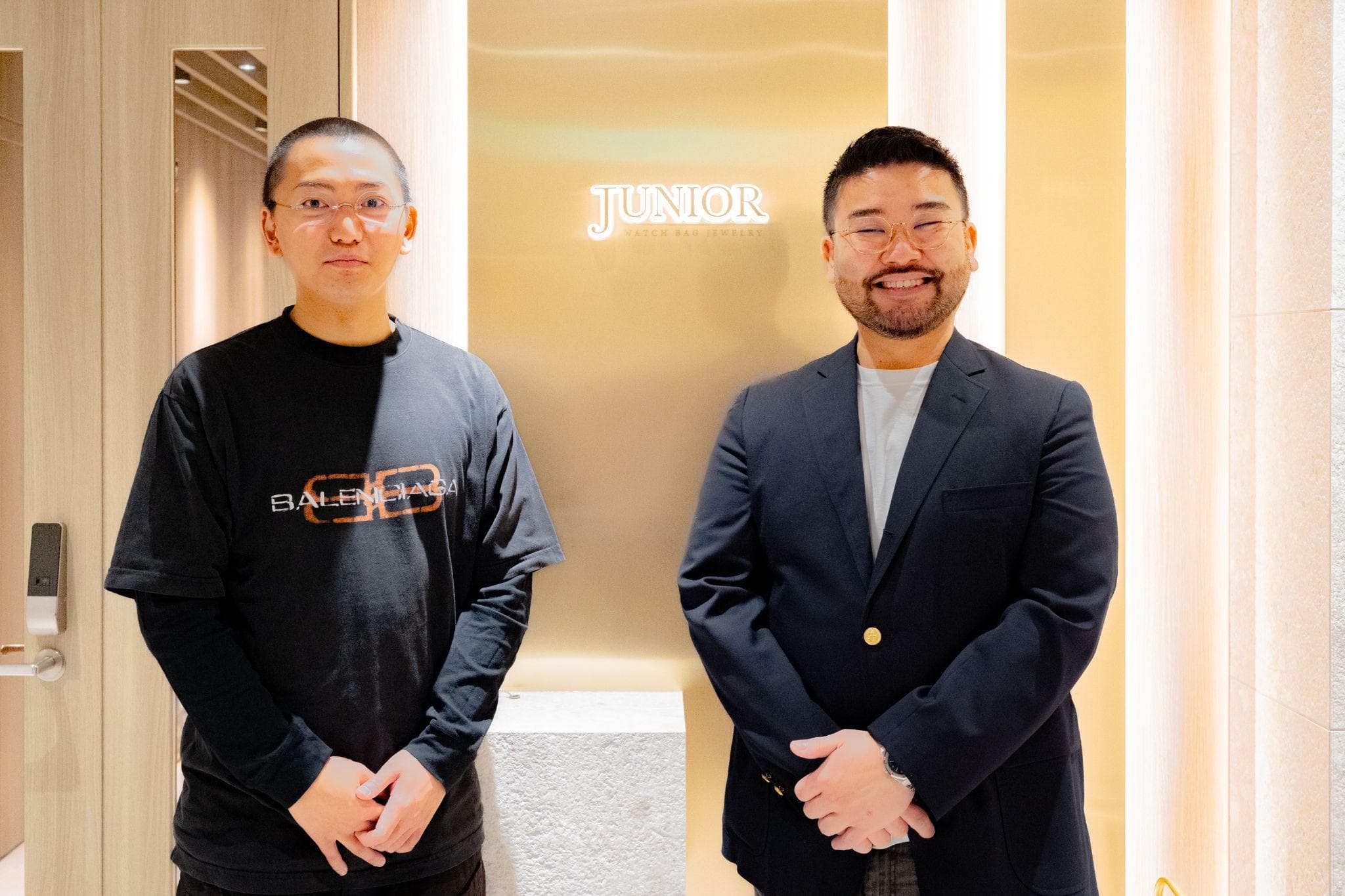
Trading luxury watches often means moving tens of millions — sometimes hundreds of millions — of yen in a single deal. For a long time, the critical moment of that process, the valuation, has been a black box powered by the intuition of veteran buyers. By adopting LAMP and BRAIN, JUNIOR Inc. dismantled that industry norm and engineered a dramatic transformation — valuations that used to take an hour now finish in five minutes, and the process no longer depends on a single expert. We spoke with two leaders who run both the systems and the frontline about the strategy behind this shift.
Highlights
- —Unified LINE Official Account and Salesforce customer data end to end
- —Cut valuation time from an hour to five minutes while eliminating key-person dependency
- —Used AI to enrich service that stays grounded in each customer's story
About JUNIOR Inc.
First, can you introduce your business and your roles?
Hirai: JUNIOR Inc. primarily buys and sells luxury watches, brand-name bags, and similar goods. We sell not only domestically but also wholesale and retail to overseas dealers, and our global sales network is a key strength.
My current responsibilities span systems architecture, new alliances, and running the roughly 20-person buyer team.
Tsujino: I'm focused on pricing decisions — both buying and selling — and I am involved in trades on both sides, including overseas transactions.
"Disconnected information" was slowing the frontline
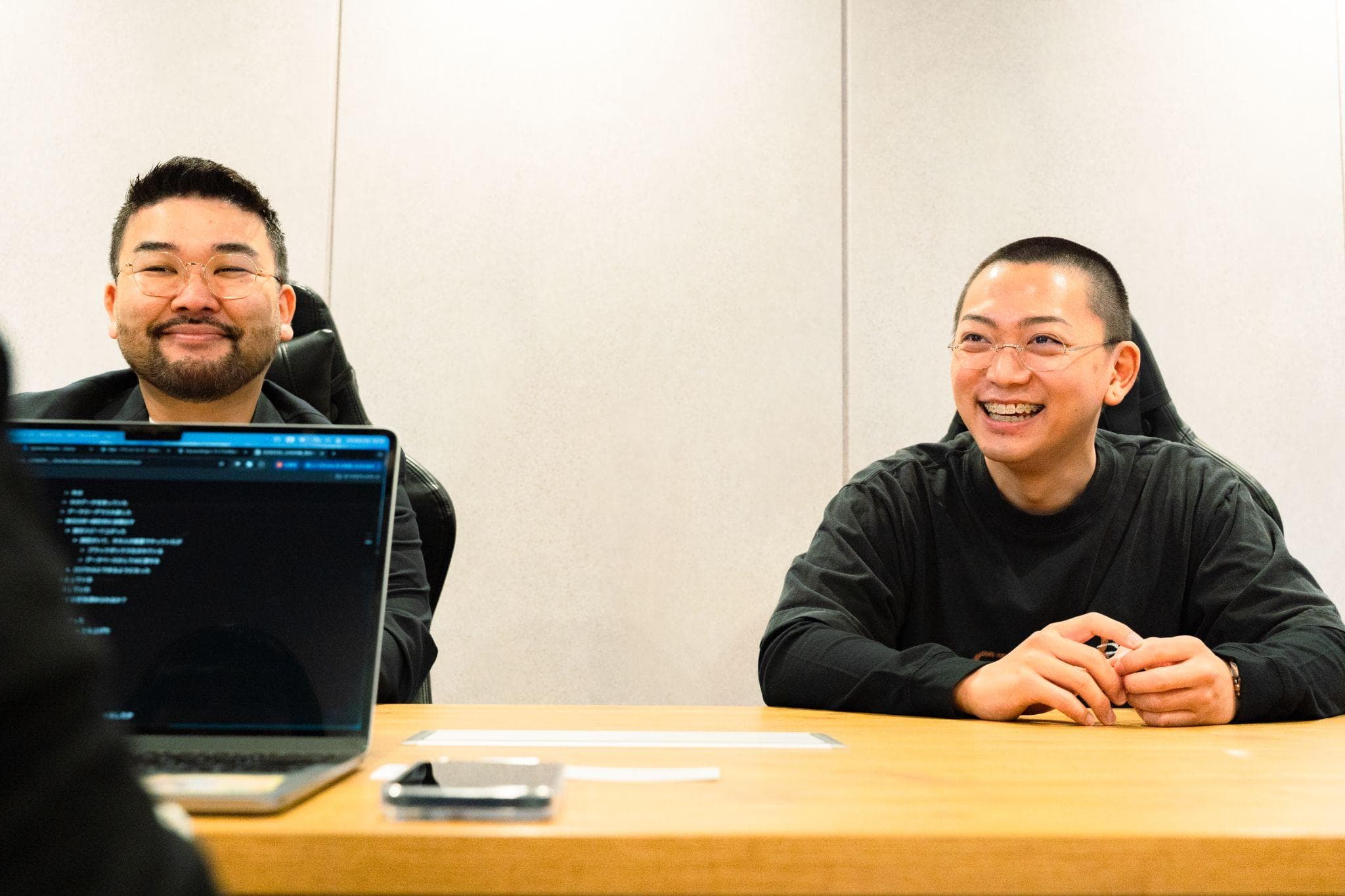
What made you look at Igness's LAMP and BRAIN in the first place?
The problem when we started looking at LAMP was fragmented customer management. Customers generally request valuations through our LINE Official Account, but customer profiles and product data lived in Salesforce. Those two worlds were disconnected, and we wanted to manage the entire flow in one place.
We evaluated other services too, but they tended to carry lots of features we didn't need, and it was hard to customize them around the way our frontline actually works. Around that time we learned LAMP had launched, and its LINE integration and focus on exactly the features we needed made it the best fit for our business, so we adopted it.
So LAMP was the first step. What about BRAIN?
With the boom in buy-back services lately, getting chosen by a customer comes down to being "faster and more accurate" with the valuation than the competition. But a major challenge across the industry is the reliance on a handful of experts.
A seasoned buyer can value a watch quickly based on years of experience. The flip side is that relying on intuition means the logic behind a quote lives inside a person, and things get missed.
That's a fragile way to run a business. When a veteran leaves, the valuation capability of the company drops and the organization weakens. We've watched many competitors fade that way. Since our founding we wanted to systematize valuation logic so that anyone — even a new hire — could produce accurate quotes quickly and deliver them to the customer without delay. That's when we came across BRAIN and decided to test it.
From one hour to five minutes — BRAIN's valuation revolution, analyzing 20,000 records

BRAIN in use
How exactly is BRAIN used in practice?
First, a customer sends a photo of the watch they want valued through our LINE Official Account. Behind the scenes we have a proprietary database with 20,000+ records, mapping watch reference numbers to our own pricing logic based on historical data.
When image recognition identifies a reference number, statistics instantly become available: our own buy history, year-by-year market prices, averages, standard deviations — all surfaced on the spot.
On top of our own data, BRAIN pulls in external signals comprehensively — pricing on e-commerce sites, the latest news, exchange rates, and other market factors that affect real-time value.
Some products have strong markets domestically and others overseas. Because we primarily sell overseas, in the past we risked missing domestic market signals. BRAIN surfaces information from channels we don't normally check, letting us make more precise valuations based on a broader picture.
So BRAIN gathers the context from both your own database and market conditions?
Exactly. What used to take a buyer hours of manual digging now happens instantly. "Our own data puts this at 4 million yen, but considering this morning's exchange-rate move and overseas auction trends, 4.2 million is a more accurate number right now" — that kind of precise answer shows up in the Salesforce screen in seconds. Work that used to take an hour now takes five minutes — and it's statistically backed rather than based on feel.
How is the buyer team reacting?
Very positively. They feel the accuracy is high and prices stay aligned with the market. For less experienced buyers in particular, a deal worth tens of millions of yen carries real emotional pressure. BRAIN acts as a trusted second opinion that reinforces their decision. As a result, all 20 buyers can maintain a consistent valuation quality regardless of how experienced they are.
Sincerity in how we use AI
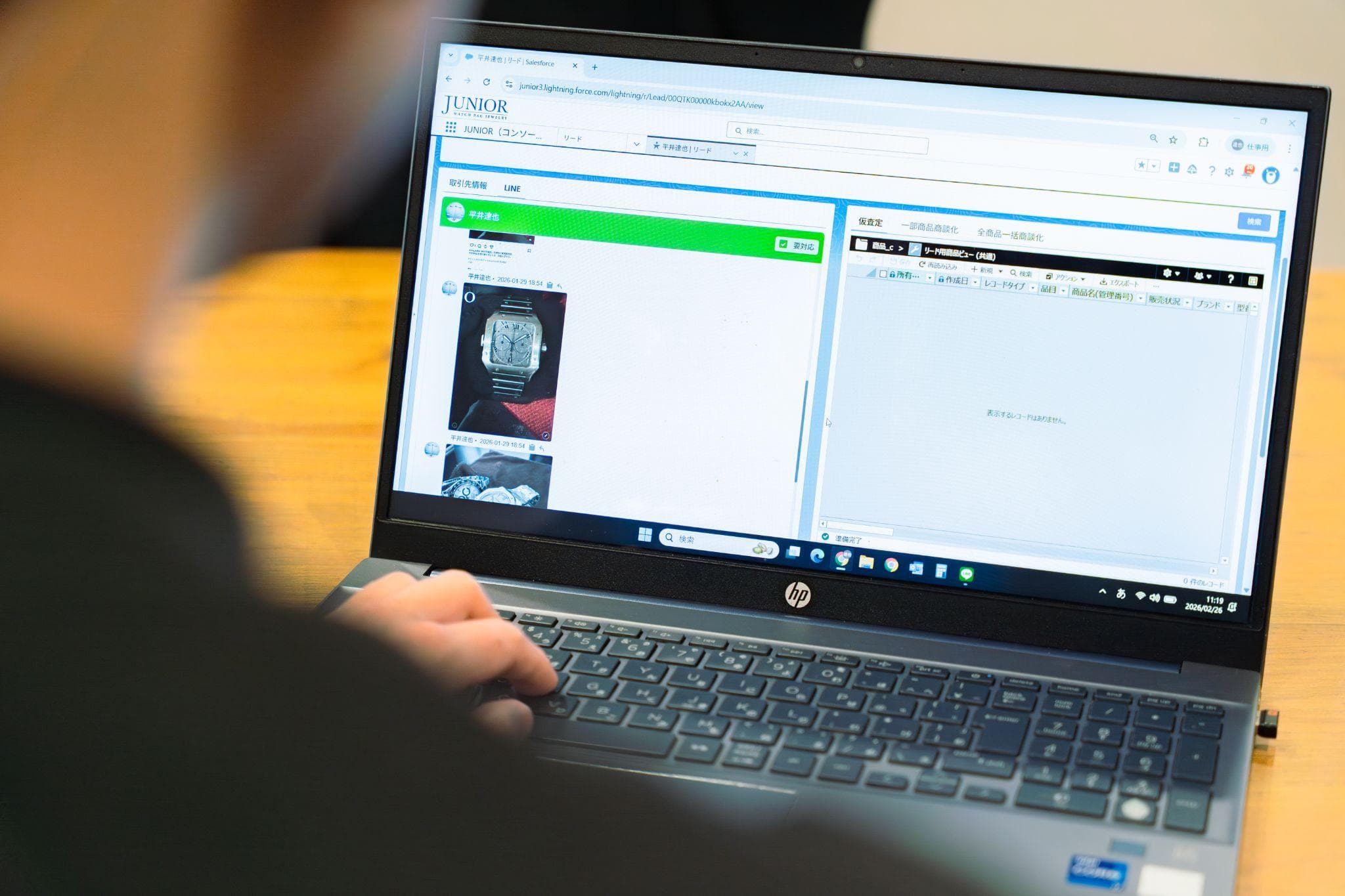
LAMP in use
Did you reach the "unified LINE + customer data" goal?
Yes. With LAMP, we can see a customer's record in Salesforce and at the same time handle the LINE conversation in the same screen. Jumping between PC and phone is gone. The jump in operational efficiency is dramatic.
The product database is also connected seamlessly. We can extract the reference number from an incoming photo and manage everything through one pipeline. That speed maps directly to better service — customers aren't kept waiting.
How are you using LAMP's agent features?
Mainly for after-hours automation. For valuation requests that arrive outside business hours, we automatically identify the reference number from a photo and send a confirmation message asking "Is this the right product?" That way, when we open next morning we can immediately look up the price and reply with a quote.
Any reason you don't automate the actual price reply?
Technically we could. For casual goods worth a few hundred yen, a fast automated answer would be great. But we're dealing with items a customer may have treasured for years, often worth millions or even hundreds of millions of yen. Returning a machine-generated number with no human judgment feels disrespectful for something that carries that weight.
When a customer chooses to sell a cherished watch, a human should be present at the moment of the decision. Let AI gather the data needed for accurate pricing quickly; a buyer takes responsibility for the final number and talks with the customer about it. That structure is why customers feel safe entrusting their assets to us.
Anything you want to tackle with LAMP going forward?
We'd like to use LAMP for follow-up messaging to customers who requested valuations in the past. Every watch has a story behind it — whether it's one of several the owner has, or a cherished single piece changes the kind of message that's meaningful. Because LAMP is linked to Salesforce, we can craft messages tailored to each customer's context, sending content personalized for every individual.
Turning Salesforce data into a weapon for customer-facing work
What do you like most about LAMP and BRAIN?
They live inside Salesforce and always work off the latest data. The UI is intuitive, so even mid-conversation with a customer we can respond quickly and with confidence.
Rollout to the team was smooth. Once an agent is configured, frontline staff can start using it immediately.
"JUNIOR Cloud" — an initiative to change the industry
We heard you're planning to offer the system externally.
We're thinking about "JUNIOR Cloud" (tentative name), which would make our Salesforce object design and BRAIN valuation logic available to the wider industry.
The secondhand goods industry has lagged on DX, and the opacity of valuations has eroded customer trust in some cases. Earning that trust requires transparent data. We want to build something where, by adopting this system, companies can say "the black box is gone" — that would become the standard for the industry. Spreading clean, clear transactions also lifts the social standing of the industry overall.
LAMP and BRAIN — humans and AI collaborating to build customer relationships
Any final words for companies considering this kind of setup?
Every industry is starting to take inquiries and requests through a LINE Official Account. If your management is split — "LINE is LINE, customer data is Salesforce" — you should adopt LAMP right away. Being able to see the LINE conversation from within Salesforce boosts operational efficiency, and any change you make to your Salesforce objects flows directly into stronger LINE service.
And BRAIN — don't treat it as just another tool. Treat it as a partner that fully leverages your unique data and creates room for humans to focus on customers. Your business and your customer relationships will change for the better.
Interview conducted in March 2026.
More about our products